


SEO stands for search engine optimisation. It is the work of making your website clear and trustworthy enough that Google shows it when someone searches for what you do.
Say you run a plumbing firm in Leeds. When someone with a burst pipe searches “emergency plumber in Leeds”, SEO is what helps your business appear in the free results they see. The work covers how Google finds your pages, what those pages say and whether other websites link to them. It also has limits, because nobody can pay Google for the top spot.
TL;DR: what SEO is and how it works
These are the main points about what SEO is:
- SEO means making your website easy for search engines to understand and easy for customers to find.
- SEO affects the free results on Google, which are the organic results and the local map results. It does not affect the paid ads.
- Google works in three stages. It finds your pages, stores them and then picks which ones to show for each search.
- SEO work covers technical fixes, on-page content and off-page links, plus local SEO for businesses that serve nearby customers.
- Nobody can pay Google for a ranking or promise a number 1 spot. Results also take time.
What does SEO mean?
Google’s own SEO Starter Guide describes SEO as “about helping search engines understand your content, and helping users find your site”. A search engine is a service such as Google or Bing that finds web pages matching what a person types in.
For a small business, the first half of that line means Google can read your pages and tell what you offer and where. The second half means people searching for that, such as someone looking for a dentist in Bristol, see your site among the results.
Our guide to common SEO mistakes lists the problems we see most often on small business websites.
SEO is ongoing work. You keep your pages accurate, keep your site working and keep your business details up to date whenever your services, opening hours or contact details change.
Work with the founders
Want someone to do this for you?
Sandcrowd works only with small and local businesses. If you want help showing up in the free map and organic results, see how our SEO for small businesses works.
Where does SEO show up on Google?
When you search on Google, the page you get back is called the search engine results page, or SERP. It has several parts, which our guide to the parts of a results page walks through one by one.
Three of those parts matter most to a local business. Organic results are the ordinary website listings that Google has not been paid to show. The local map results are the businesses Google lists next to a map when someone searches for a local service, such as “florist near me”. Your Google Business Profile is the business listing you manage on Google, which shows details such as your address and opening hours.
This table shows whether you can pay for a place in each part and what puts a business there:
| Part of the results page | Can you pay for the position? | What puts you there |
|---|---|---|
| Ads, labelled “Ad”, “Ads” or “Sponsored” | Yes | A Google Ads campaign |
| Local map results | No | Your Google Business Profile and your website |
| Organic results | No | Your website |
SEO works on the two unpaid parts, the map results and the organic results.
How does SEO work?
According to Google’s guide to how Search works, Google handles pages in three stages called crawling, indexing and serving search results. SEO is the work of making each stage go well for your pages.
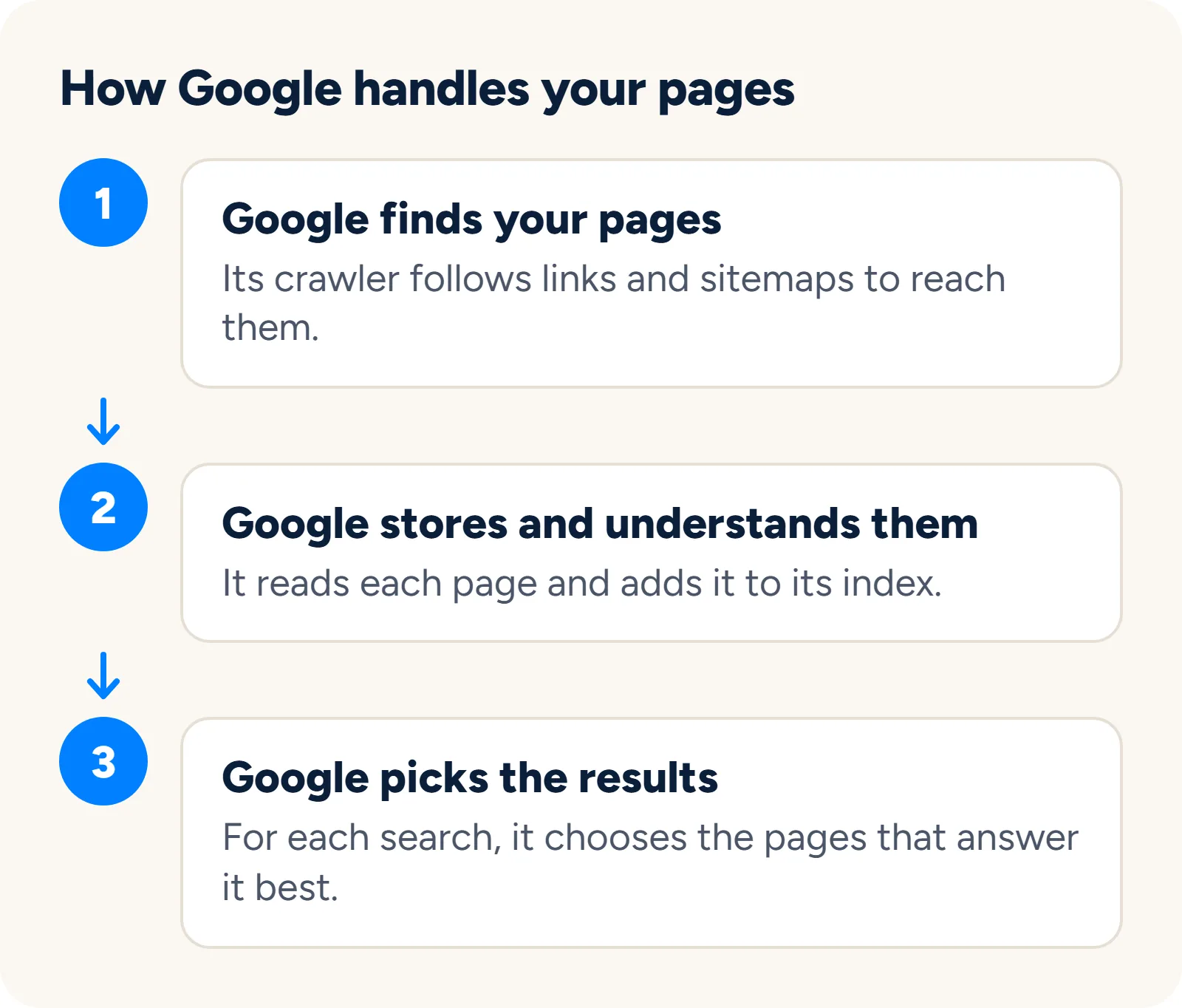
Each stage depends on the one before it:
1. Google finds your pages
The first stage is called crawling. Google uses automated programs called crawlers to download the text, images and videos from pages it has found. Its main crawler is called Googlebot.
Google finds new pages by following a link from a page it already knows, or through a sitemap, which is a file where you list the pages on your site. So a page that nothing links to, and that is missing from your sitemap, may never be found.
Google says the vast majority of sites in its results are found and added automatically. You do not need to pay anyone to submit your site.
2. Google stores and understands them
The second stage is called indexing. Google analyses the text, images and video on a page and stores that information in the Google index, which is the database of pages it can choose from. If several pages are near-duplicates, Google groups them and picks the one that best represents the group.
A page that is not in the index cannot appear in results. To check yours, type site:yourdomain.co.uk into Google, using your own web address. This is called the site: search operator. Google’s starter guide says that if results from your site appear, your site is in the index.
3. Google picks the results for each search
The third stage is serving. When someone searches, Google returns the pages it judges most relevant to that search. Its guide to ranking results says its systems look at the words of the search, the relevance and usability of pages, the expertise of sources, and the searcher’s location and settings.
Work with the founders
Short on time for SEO?
Sandcrowd covers all four parts of SEO for small and local businesses on an affordable monthly retainer.
The same guide says the weight of each factor varies depending on the search. Ranking is done programmatically, which means automated systems pick the order. Our guide to Google ranking factors covers each factor in more detail.
What are the four parts of SEO work?
SEO work is usually split into four parts. Each part makes one or more of Google’s three stages go better for your pages.
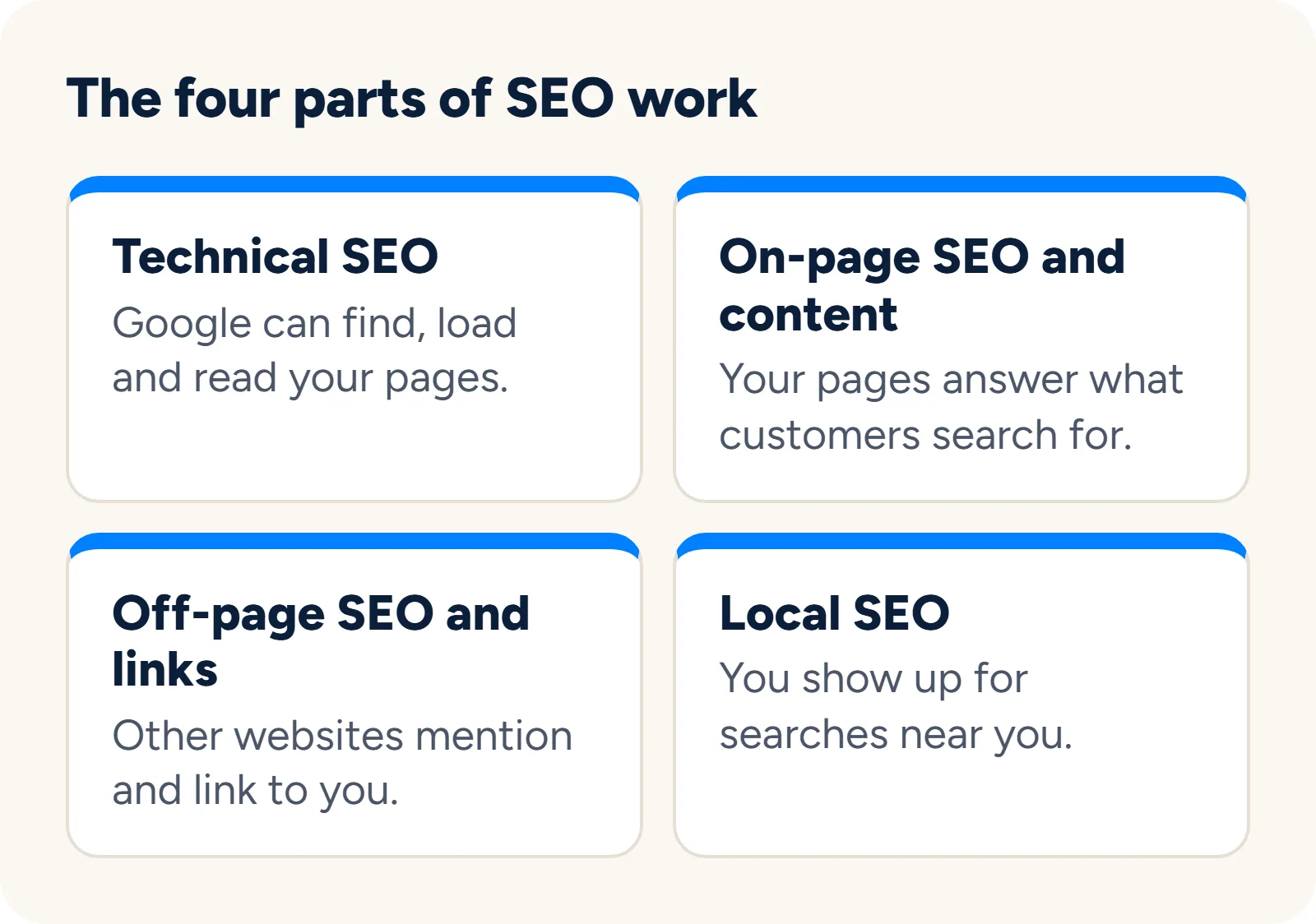
These are the four parts and the stages each one affects:
1. Technical SEO
Technical SEO makes sure Google can crawl and index your site, so it covers the first two stages. That means links Google can follow, an up-to-date sitemap and checks that no site setting is hiding pages from Google by mistake. A pattern we see often on small business sites is a service page that no menu or other page links to, so Google may never find it.
Technical SEO also covers how the site works for visitors. Google’s ranking guide says its systems look at page experience, such as “mobile-friendly content that loads quickly”. So the speed of your site and how it works on a phone are part of what Google weighs when it picks results.
2. On-page SEO and content
On-page SEO is the work on the pages themselves. It matters most in the serving stage, when Google compares pages with the words of a search.
A keyword is a word or phrase a customer types into Google, such as “boiler service Bristol”. Your pages should answer what customers search for, using their words.
Each page also needs a clear title, which is the page name Google often shows as the clickable headline in its results. Google’s starter guide says a good title is unique to the page, clear and concise. It asks the same of the meta description, which is the short summary that can appear under the title. The guide also says keyword stuffing, which means repeating words in an unnatural way, is against Google’s spam policies.
3. Off-page SEO and links
Off-page SEO is the work that happens beyond your own site, mainly links. A backlink is a link from another website to yours.
Backlinks matter in the crawling and serving stages. Google follows links to find new pages. Its ranking guide also says one way it judges quality is whether “other prominent websites link or refer to the content”.
The links worth having come from real relationships with suppliers, local associations and local press. Buying or selling links for ranking purposes is link spam under Google’s spam policies and can harm your site. Our guide explains what backlinks are in more detail.
4. Local SEO
Local SEO is the work aimed at the local map results, which Google picks in the serving stage. It matters for any business that serves customers in a particular area, such as a clinic, a trade or a shop.
Google Business Profile Help says local results are mainly based on three things:
- Relevance: This is how well your Business Profile matches what the person searched for.
- Distance: This is how far your business is from the place named in the search, or from the searcher if they name no place.
- Prominence: This is how well known your business is. Google says it takes in how many websites link to your business and how many reviews you have.
Google also says businesses with complete and accurate information are more likely to show up. So filling in your profile fully, including your categories, opening hours and contact details, is a core part of local SEO.
What SEO cannot do
SEO has limits that no agency or tool can get around. Google sets them out in its own help pages.
Free plan
Got 20 minutes a day?
Our free 30-Day Local SEO Plan gives you one small task a day, in the order that matters.
These are the three limits to know before you spend time or money on SEO:
- No paid rankings: Google does not accept payment to rank pages higher in its organic results. Google Business Profile Help also says there is no way to request or pay for a better local ranking.
- No promised number 1: Google says no one can promise a number 1 ranking on Google. So treat any promise of one as a warning sign.
- No instant results: Google’s starter guide says some changes take effect in a few hours and others could take several months. In our experience, many sites see early movement within about 3 to 6 months. Competitive searches take longer.
FAQ about SEO
These are short answers to other questions owners often ask about SEO:
Can I do SEO myself?
Yes, you can do many of the basics yourself, such as completing your Google Business Profile and checking which pages Google has indexed. Technical fixes and link building take more time and skill, so those are the parts where outside help is often worth it. Our guide to SEO for beginners covers the first steps.
Does SEO only work for Google?
No, the same basics apply to other search engines, such as Bing. Bing has its own free webmaster tools where you can check how it sees your site.
Is SEO the same as Google Ads?
No, they are separate things. Google Ads is Google’s paid advertising service, which shows your ad in spaces labelled “Ad” or “Sponsored” while your campaign runs. SEO works on the unpaid organic and map results, which Google does not sell.
What SEO means for your business
Google’s three stages also give you an order for checking your own site. First, use the site search from earlier to confirm your main pages are indexed. Then check that each page answers a search a real customer would type. If you serve a local area, complete your Google Business Profile too.
Free SEO audit
Find out what your site needs first
Answer a few quick questions about your business and get your free SEO audit, with the first things to fix.
If you would rather hand that work over, Sandcrowd works only with small and local businesses. We handle all four parts of SEO on an affordable monthly retainer. You work directly with our two founders and get regular reports and calls.